
The short answer
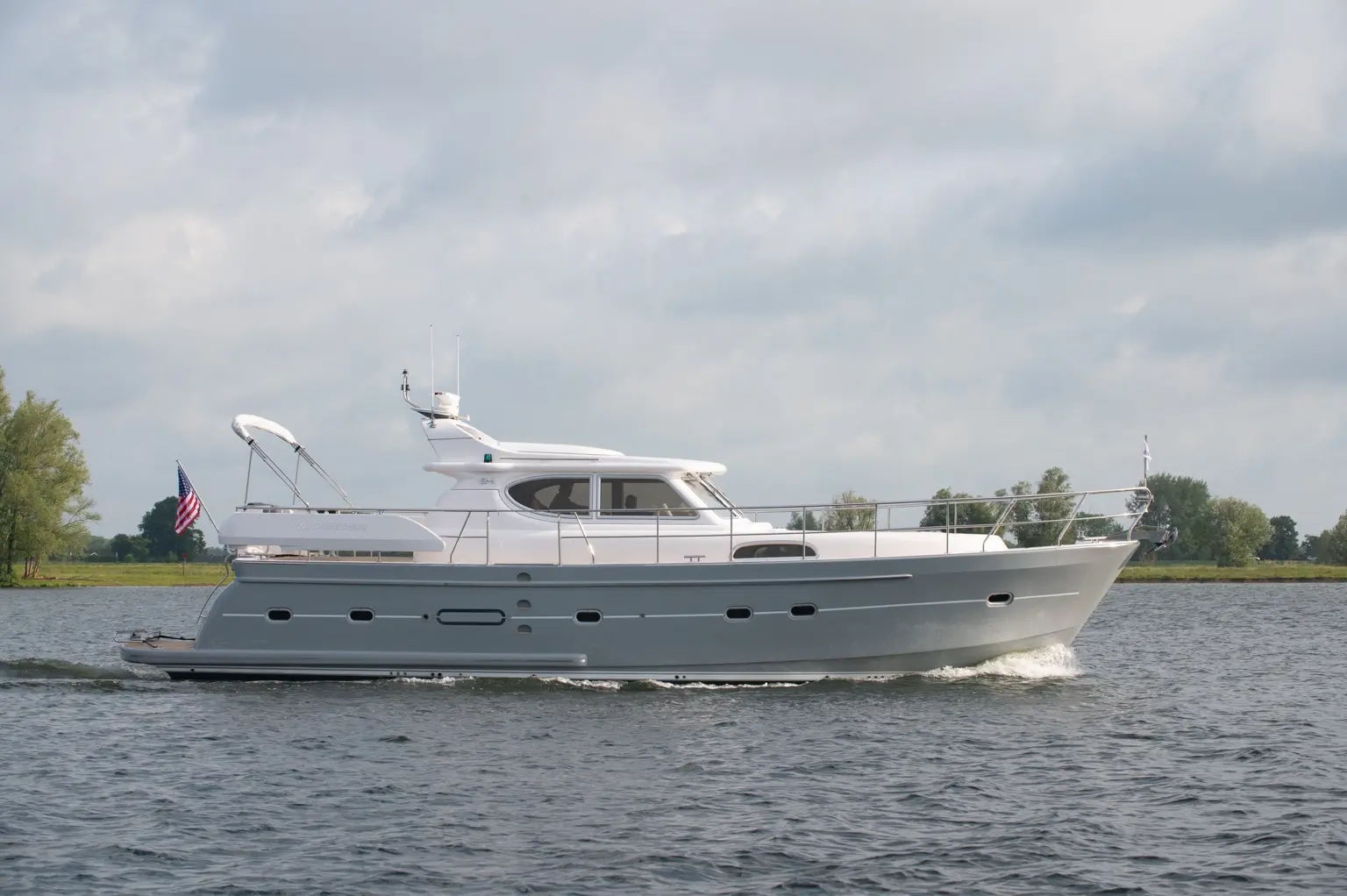
Three standard-production Elling E4s crossed from the Canary Islands to St. Maarten in December 2008. The yachts were prepared for that specific nonstop passage with additional temporary fuel capacity. That distinction matters: the crossing demonstrated the platform’s capability, not that every standard-tank Elling should simply point west and depart.
What serious buyers should remember
- The E4’s Atlantic record is real-world evidence, not merely a theoretical range claim.
- The crossing yachts carried passage-specific fuel beyond their normal fixed tanks.
- Efficient low-speed operation is central to ocean range; reserve speed serves a different purpose.
- CE Category A is a demanding design category, but it never replaces seamanship or weather judgment.
The crossing that answered the question
The original Elling brief, established in 1997, was unusually specific: create a production motor yacht under 15 meters that could complete a transatlantic passage without surrendering the comfort and route flexibility expected of a cruising yacht. In 2008, three E4s put that idea to the test on a westbound passage from La Palma in the Canary Islands to St. Maarten.
The boats were standard-production E4s in the ways that mattered most—the hulls, main propulsion and essential systems were not one-off prototypes. They did, however, receive the kind of preparation any serious passagemaker should expect, including temporary fuel carried for a leg longer than the yachts’ standard-tank range. Near the end of the passage, the group used the auxiliary propulsion systems after one boat developed a vibration, illustrating why Elling treats redundancy as operational equipment rather than brochure decoration.
Range comes from slowing down
At displacement speed, an E3 or E4 moves with dramatically less resistance than it does in the higher semi-displacement speed band. Historical factory data used roughly 7.5 knots and about 1 liter per nautical mile as the economical reference point, producing a theoretical 1,500-nautical-mile figure from 1,500 liters. Fuel consumption rises sharply as speed increases, so long-range operation depends on slowing down.
That contrast explains the design logic. Higher speed is valuable when daylight, weather, traffic or schedule makes it useful. Lower speed is where long-range work happens. The published economical figure should not be treated as a voyage plan: prudent range calculations subtract an appropriate reserve and account for generator use, wind, current, sea state, loading, hull condition and the exact engine-propeller combination.
| Operating point | Published fuel use | Published range | What it illustrates |
|---|---|---|---|
| About 7.5 knots | About 1 L/nm | About 1,500 nm | Economical displacement-speed cruising |
What makes the platform credible offshore
The range number is only one part of the answer. Elling combines CE Category A (Ocean) construction with an aramid-fiber-reinforced composite hull, a low center of gravity, protected shaft propulsion, high handrails, double-glazed saloon windows, fire and high-water alarms, and extensive machinery-space insulation. The E4’s self-righting heritage and optional independent auxiliary engine address low-probability, high-consequence events that ordinary coastal designs may not prioritize in the same way.
Comfort is also a safety factor. A quiet wheelhouse, supportive seating, usable galley, good visibility and a protected watchkeeping position reduce fatigue. The value is not that difficult conditions become pleasant; it is that crew can continue making sound decisions when a passage becomes tiring.
The right question before any long passage
Instead of asking only whether the yacht can cross, ask whether this yacht, in its present specification, with this crew, on this route and in this season has acceptable margins. That leads to a much better conversation about tankage, service status, stabilisation, electrical endurance, communications, medical preparation, spare parts and diversion options.
For most American owners, the first ambitious cruises will be coastal passages, the Bahamas, the Great Loop or seasonal runs between New England and Florida. The same fundamentals still matter. Elling’s advantage is that the underlying platform leaves room to build experience without making a future ocean ambition unrealistic.
Evidence base
Sources & evidence
Factory publications are used for Elling history and specifications; regulatory guidance comes from the responsible public authority. Contemporaneous reporting is identified where it documents a historical passage detail. Current build specifications always control over historical material.