
The short answer
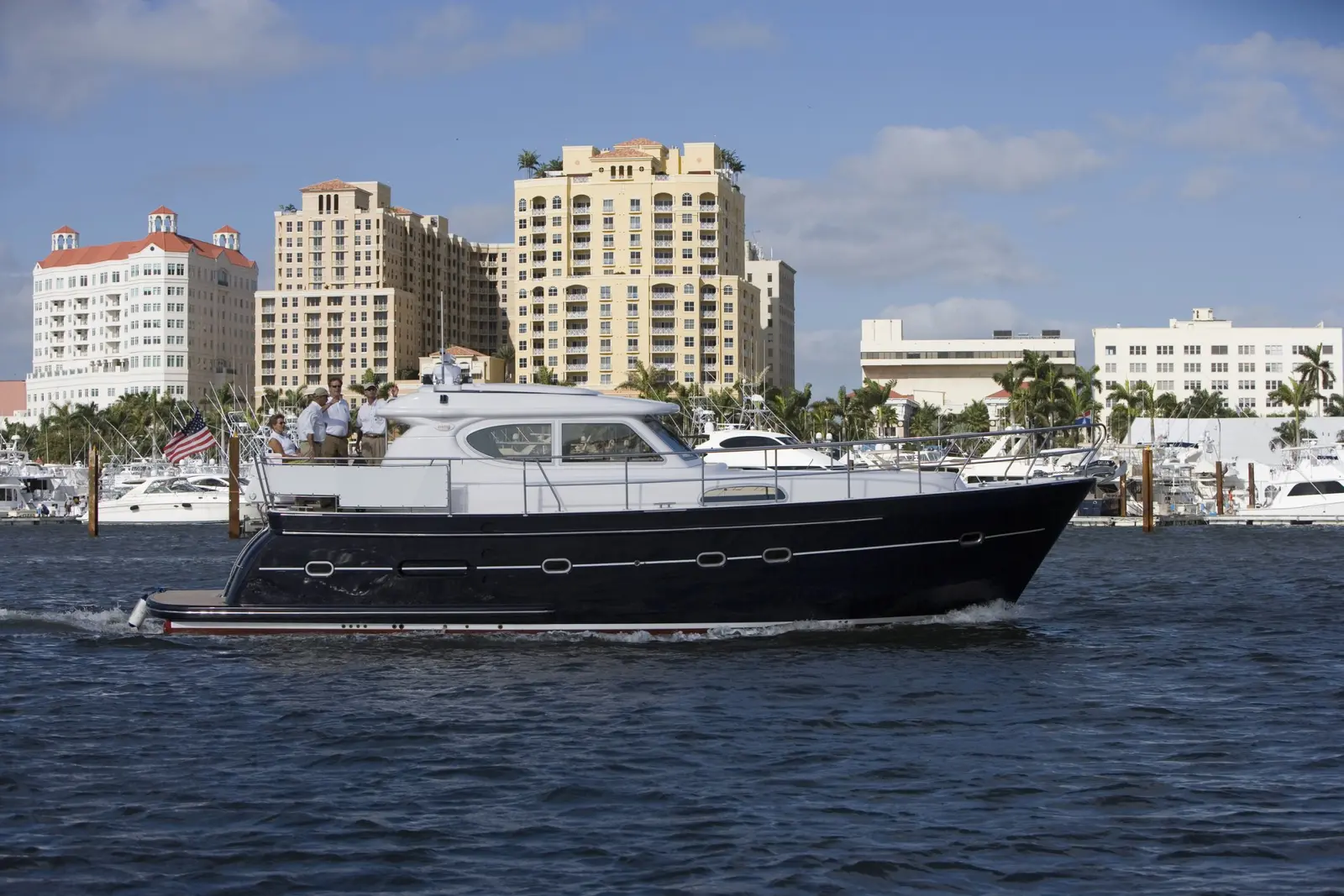
A full-displacement yacht remains supported primarily by buoyancy and is optimized for efficient low-speed travel. A semi-displacement yacht also runs efficiently at modest speed but can generate enough dynamic lift to move beyond its traditional displacement-speed band. Elling chose the second approach to combine long-range economy with useful reserve speed.
What serious buyers should remember
- Full-displacement hulls prioritize low-speed efficiency, load carrying and range.
- Semi-displacement hulls accept more power and fuel burn to make higher speeds possible.
- Motion, comfort and seaworthiness depend on the complete design—not the label alone.
- Elling owners can select speed by mission: economical passage or faster coastal leg.
What changes as a yacht accelerates
At low speed, both hull types push water aside and are supported mainly by buoyancy. As speed increases, wave-making resistance grows. A conventional full-displacement hull approaches a practical speed region where producing the next knot requires disproportionate power because the hull is trying to climb its own wave system.
A semi-displacement hull has geometry and power that allow part of the yacht’s weight to be supported dynamically. It does not become a flat-bottomed planing boat, but it can move beyond the speed band where a pure displacement yacht of similar waterline length would be constrained. The transition is gradual, which is why fuel use should be considered as a curve rather than two neat modes.
The tradeoffs in plain language
A purpose-built full-displacement hull can carry substantial fuel and stores while extracting excellent range from modest horsepower. Its deeper, heavier form may deliver the slow, predictable motion desired for passagemaking. It generally cannot offer a sudden increase into the high teens simply by installing a larger engine.
A semi-displacement yacht offers a wider useful speed envelope. The owner can slow down for range, then use more power when conditions or schedule justify it. The price is larger installed horsepower, higher consumption at the upper end and a hull that must balance two operating regimes rather than optimize only one.
| Characteristic | Full displacement | Semi-displacement |
|---|---|---|
| Primary priority | Range and low-speed efficiency | A broader speed envelope |
| Higher-speed ability | Limited by displacement-wave resistance | Can move beyond conventional hull speed |
| Installed power | Usually lower for length and weight | Usually higher to reach upper speed band |
| Fuel curve | Best within a relatively narrow low-speed range | Economical low; rises sharply with speed |
| Best fit | Owners committed to steady passagemaking speeds | Owners mixing long range with time-sensitive legs |
Why Elling chose semi-displacement
The Elling mission is broader than crossing oceans. An E-Series yacht may run the Great Loop, pass beneath European canal bridges, spend a season in the Bahamas, travel the U.S. East Coast and later make an offshore passage. Shallow draft and a lowering mast help with the first group of routes; Category A construction and economical displacement-speed operation support the second.
Reserve speed completes that mission. Depending on model and engine choice, an Elling can operate well above displacement speed, yet owners planning maximum range will normally slow to the efficient portion of the curve. The yacht does not force one pace onto every day of the itinerary.
Do not use hull type as a shortcut for comfort
A heavy displacement yacht is not automatically comfortable in every sea, and a semi-displacement yacht is not automatically harsh. Comfort depends on length, beam, weight distribution, bow shape, deadrise, stabilisation, loading, heading and speed. Noise, visibility, helm protection and interior ergonomics also determine how tiring a passage feels.
The proper evaluation combines drawings and numbers with an underway trial. Run the yacht at displacement speed, through the transition and at the intended fast cruise. Turn across the wake, listen from the owner’s cabin and lower saloon, and examine how safely a crew can move between helm, galley, berths and deck.
Evidence base
Sources & evidence
Factory publications are used for Elling history and specifications; regulatory guidance comes from the responsible public authority. Contemporaneous reporting is identified where it documents a historical passage detail. Current build specifications always control over historical material.