
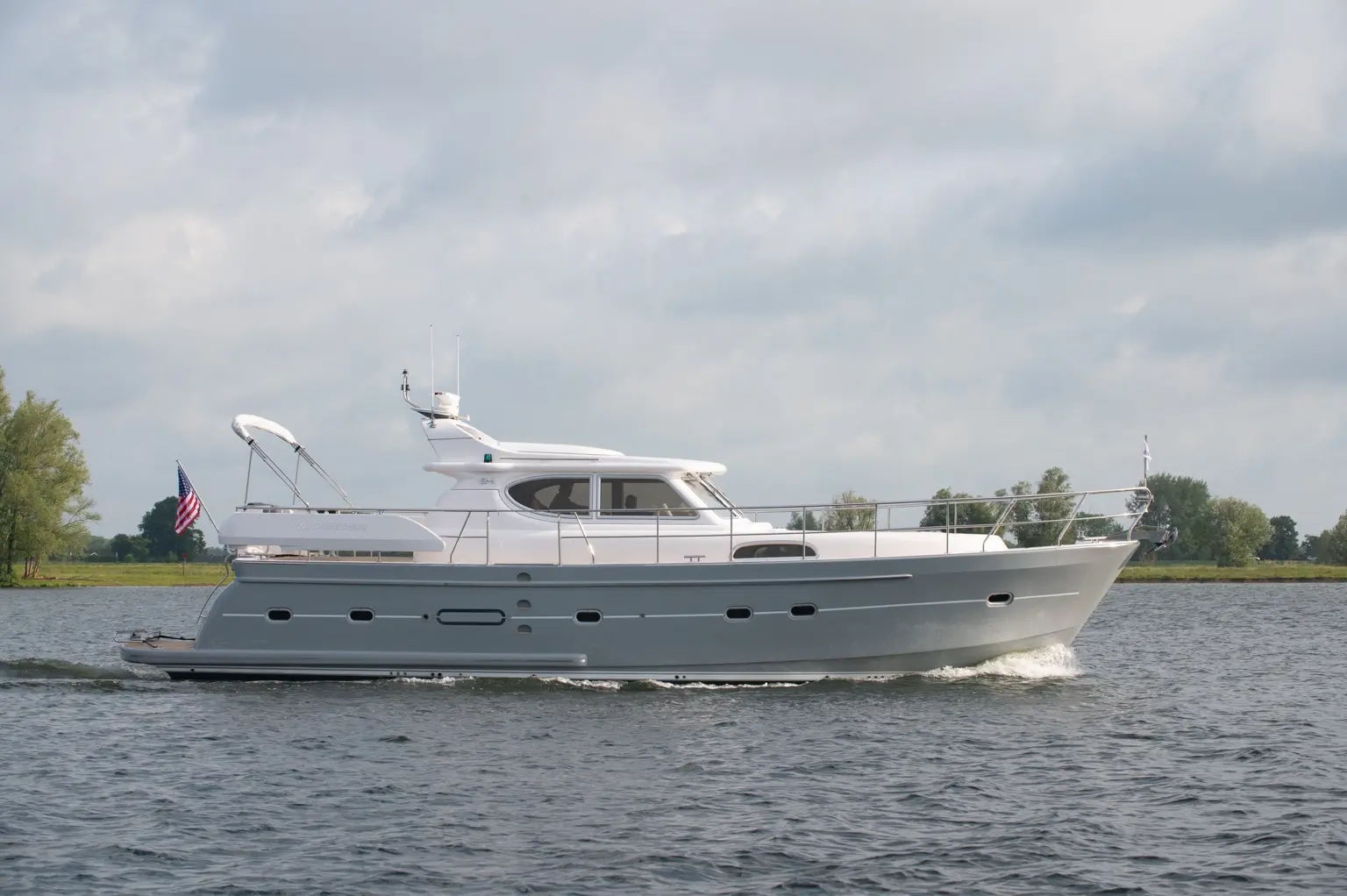
The short answer
Yes. The Elling E4’s approximately 4-foot draft, electrically lowering mast, protected pilothouse, efficient low-speed operation and useful reserve speed make it a compelling Great Loop yacht. Its 49-foot length and three-cabin interior provide genuine liveaboard comfort without moving into full-time-crew territory. Owners must still verify the exact yacht’s loaded bridge clearance, draft and route restrictions before departure.
What serious buyers should remember
- The lowering mast and shallow draft support bridge-limited and shallow-water sections of the route.
- Efficient displacement-speed cruising suits long days, while reserve speed can help with weather, current and timing.
- A protected helm, full-beam owner’s stateroom and generous storage matter during a year aboard.
- The E4 is Category A (Ocean), but route planning, local notices and prudent weather decisions remain essential.
Why the Great Loop rewards a versatile yacht
The Great Loop is not one type of cruising. It can include the Intracoastal Waterway, broad rivers, locks, the Great Lakes, Canadian waterways and exposed coastal legs. A yacht optimized only for offshore passagemaking may carry more draft or height than the inland portions welcome; a purely inland boat may be less comfortable when the route opens onto larger water.
The E4 was designed around that mixed mission. It can cruise economically at displacement speed, accelerate when conditions or schedules make that useful, and bring offshore structure and a protected wheelhouse to sections where weather can change quickly. That range of capability is more useful on the Loop than a single maximum-speed or maximum-range figure.
Draft, bridge clearance and the lowering mast
The E4’s published draft is approximately 4 feet, and its electrically operated mast lowers for restricted clearances. Those dimensions suit many Loop routes and side trips, but published figures are only a starting point. Actual draft and air draft change with load, tender, antennas, electronics, fuel and water.
Before departure, owners should measure the completed yacht in cruising condition and keep the verified figures at the helm. Water levels, bridge status, lock closures and temporary restrictions can change, so the current route must be checked rather than assumed from a previous season’s itinerary.
| Characteristic | E4 reference | Why it matters |
|---|---|---|
| Length overall | 49 ft / 14.95 m | Liveaboard space in an owner-operated package |
| Draft | About 4 ft / 1.20 m | Useful for the ICW, marinas and many side trips |
| Bridge clearance | About 11 ft 4 in / 3.45 m with mast lowered | Supports bridge-limited inland routing; verify the finished yacht |
| Fuel capacity | 396 US gal / 1,500 L | Comfortable planning flexibility between fuel stops |
What matters after the first thousand miles
Loopers spend months aboard, so everyday livability matters as much as helm specifications. The E4 provides a full-beam aft owner’s stateroom, a forward guest cabin, a configurable side cabin, a separate lower saloon and an enclosed pilothouse. Guests can join without taking over the owner’s space, while the side cabin can become storage or an office when two people are cruising alone.
Double glazing, deep insulation, heating and air-conditioning options help across the Loop’s varied seasons. Bow and stern thrusters simplify close-quarters handling, and high side rails support safer movement along the deck. As with any 49-foot yacht, docking skill and a practiced line-handling routine remain more valuable than relying on equipment alone.
The tradeoffs to consider honestly
The E4 is not the smallest or least expensive boat capable of completing the Loop. Owners who prioritize the easiest possible slip availability, minimal systems and very low operating cost may prefer a smaller cruiser. Buyers who want a flybridge may also favor a different layout, although avoiding a flybridge helps the Elling keep weight and clearance low.
The E4 makes the most sense for owners who see the Loop as one chapter rather than the yacht’s only job—perhaps followed by the Bahamas, New England, the Caribbean or a longer offshore passage. Its value lies in avoiding the need to change yachts when the cruising ambition expands.
Evidence base
Sources & evidence
Factory publications are used for Elling history and specifications; regulatory guidance comes from the responsible public authority. Contemporaneous reporting is identified where it documents a historical passage detail. Current build specifications always control over historical material.