
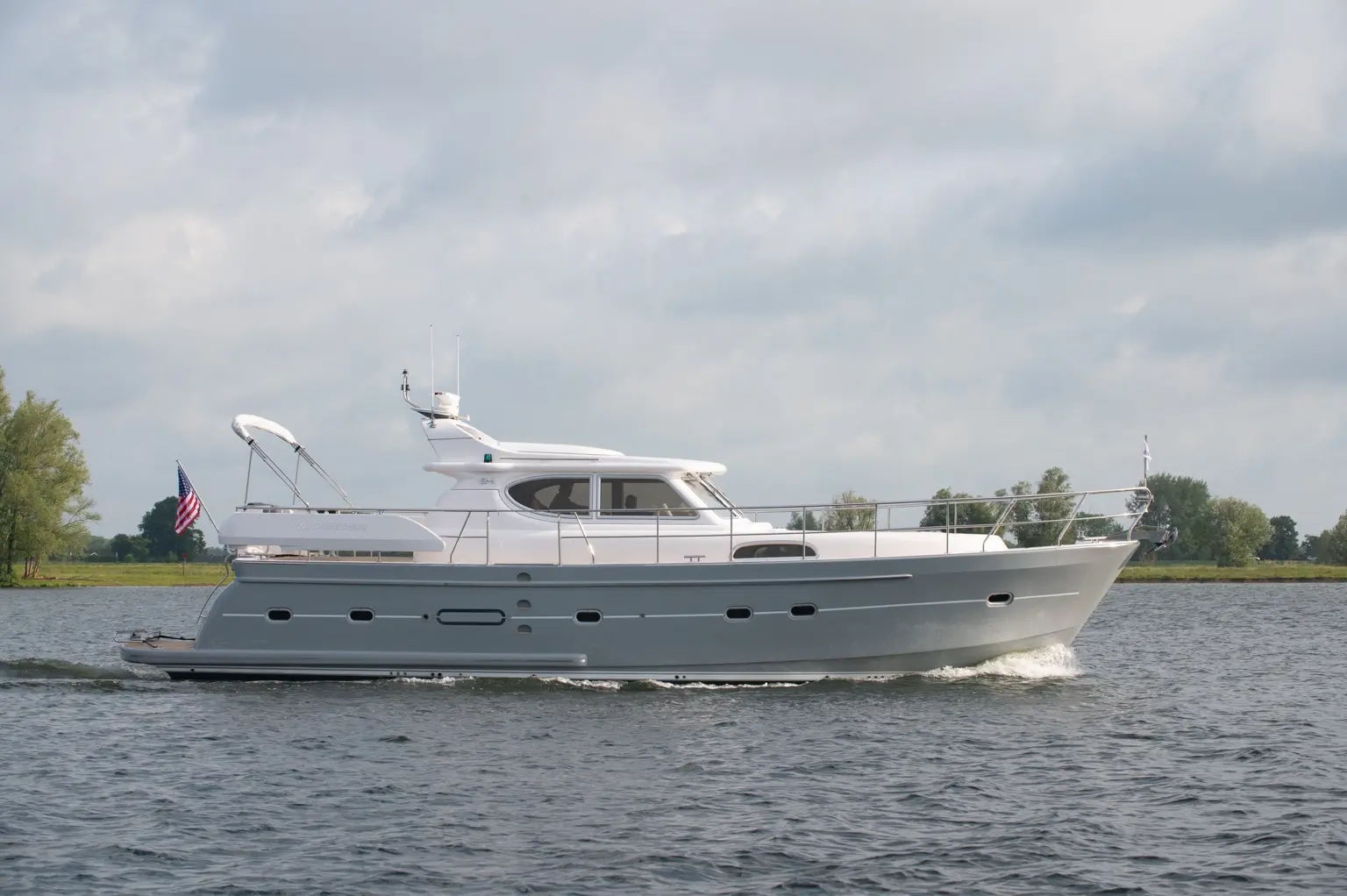
The short answer
Choose the Elling E4 when your mission mixes offshore passages with the Great Loop, Intracoastal Waterway, Bahamas, canals or time-sensitive coastal runs. Choose a purpose-built full-displacement trawler when maximum low-speed range and displacement motion outrank shallow draft, bridge access and reserve speed. Neither answer is universally better.
What serious buyers should remember
- The E4 is a semi-displacement, single-main-engine yacht with an optional independent auxiliary engine.
- Its approximate 4-foot draft and lowering mast open routes many larger passagemakers cannot use.
- A full-beam owner’s stateroom and three-cabin plan make unusually efficient use of 49 feet.
- The right comparison starts with your routes, pace, crew and maintenance preferences—not brand reputation alone.
Begin with the cruising mission
Buyers often compare the E4 with Fleming, Grand Banks, Nordhavn, Selene and other respected long-range yachts. That is sensible, but model names alone hide the most important differences. Some alternatives are full-displacement; some are semi-displacement. Some favor twin engines and a flybridge; others prioritize a protected pilothouse, maximum tankage or a wider beam.
Write down the routes you genuinely expect to cruise during the first five years. Include the shallowest water, lowest fixed bridge, longest leg without fuel, coldest and hottest season, normal crew size, preferred cruise speed and whether you will maintain the yacht yourselves. Once those answers are visible, much of the comparison becomes objective.
Where the E4 makes a different trade
The E4 keeps beam to approximately 14 feet, draft to approximately 4 feet and air draft to about 11 feet 4 inches with the mast lowered. That geometry is unusually versatile for a Category A yacht with a full-beam aft owner’s cabin, two saloon areas and three flexible cabin spaces.
Propulsion is equally distinctive. One central main engine reduces machinery count and helps keep weight low. The optional get-home engine is not simply a second copy beside the first: it has its own fuel supply, saildrive and folding propeller. This can preserve propulsion after a fouled main propeller or contaminated main fuel, two failure modes that duplicated main engines may not solve.
| Question | Elling E4 approach | Traditional trawler alternatives may favor |
|---|---|---|
| Hull speed | Efficient at low speed, with higher semi-displacement speed available | Maximum low-speed efficiency and range |
| Propulsion | Single main plus optional independent auxiliary | Twin mains or a single continuous-duty main |
| Route access | About 4 ft draft and lowering mast | Greater draft, height, beam or tank volume |
| Upper helm | Protected all-weather wheelhouse; no flybridge | Open-air flybridge visibility and entertaining |
| Interior | Two saloons, full-beam aft owner’s cabin, flexible third cabin | More beam, larger engine room or different passagemaking berths |
Reserve speed is useful—but it is not free
Depending on engine selection, the E4 can move into the high teens. That can help reach an inlet before dark, shorten exposure to a weather change or cover a coastal leg within a favorable tide. A full-displacement yacht of similar waterline length generally cannot make the same jump, regardless of added horsepower.
The cost appears immediately in fuel burn and range. Historical E4 figures show the contrast clearly: economical running near 7.5 knots versus substantially higher consumption around 16 knots. A buyer who expects to run fast most of the time should budget and size the mission accordingly; a buyer who values range will still spend most long-distance hours at displacement speed.
Compare the ownership experience, too
A machinery layout with one main engine can reduce routine service items, but every engine room should be judged on access, ventilation, service clearances and the availability of trained support. Twin engines offer familiar redundancy and maneuvering characteristics, yet duplicate many maintenance tasks. An auxiliary system adds its own inspection schedule but is designed around failure independence.
Finally, spend time underway—not only at the dock. Evaluate sightlines, sound, helm ergonomics, handholds, galley security, berth access and motion at the speeds you will actually use. The E4’s case is strongest when the entire itinerary matters: ocean, coast, canal and home port rather than one idealized passage.
Evidence base
Sources & evidence
Factory publications are used for Elling history and specifications; regulatory guidance comes from the responsible public authority. Contemporaneous reporting is identified where it documents a historical passage detail. Current build specifications always control over historical material.